The Legend of Shennong: How a Single Leaf Became Tea
Every tea culture has an origin story. Japan has the monk and his eyelids. India has the prince and the meditation. China — the place where tea actually began — has the best one of all.
It stars an emperor with a transparent belly, a man who poisoned himself for a living, and one very lucky leaf.
This is the legend of Shennong, the Divine Farmer. It’s the story almost every Chinese tea book opens with, and it goes something like this.
The Man Who Tasted Everything
Thousands of years ago — the story is usually dated to around 2737 BCE, though nobody can say who was counting — there was an emperor named Shennong.
Shennong wasn’t like other emperors. He didn’t care about palaces or wars. He cared about one question: which plants can we eat, and which ones will kill us?
Someone had to find out. So Shennong volunteered — by eating everything himself.
According to the legends, he had a transparent belly. His people could literally watch a plant travel through his body and see what it did to him. That detail sounds like a fairy tale (it is one), but it’s also a neat metaphor: Shennong was the ancient world’s food and drug tester, and the knowledge he gathered became the foundation of Chinese agriculture and herbal medicine.
The old texts say he tasted hundreds of herbs a day. And it went about as well as you’d expect.
Seventy Poisons in One Day
One ancient pharmacopoeia — the Shennong Ben Cao Jing, the Divine Farmer’s Classic of Materia Medica — contains a line that tea people love to quote:
Shennong tasted a hundred herbs, and encountered seventy-two poisons in a single day. He used tu [tea] to relieve them.
Seventy-two poisons. One day. By any modern standard, Shennong was having a spectacularly bad Tuesday.
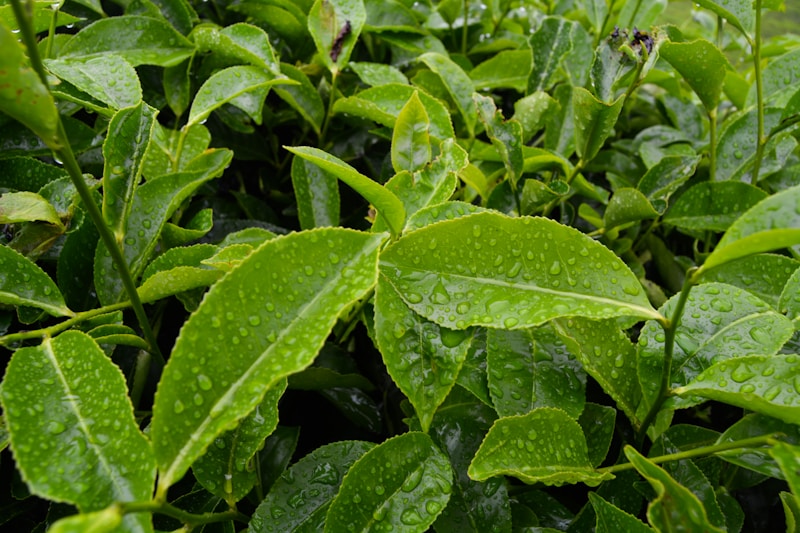
But according to the legend, there was one plant that kept him alive: a tree with glossy, serrated leaves. Whenever the poisons hit, he would chew the leaves of this plant and feel the toxicity drain away — clear-headed, awake, restored.
The Leaf and the Pot
Now for the scene every tea drinker knows.
One evening, Shennong was resting beside a fire, boiling water in a pot — a habit the ancients had, wisely, to make water safe. As he waited, a few leaves drifted down from the tree above him, carried by the wind, and landed in the boiling water.
He watched the water turn pale gold-green. He smelled something he’d never smelled before — grassy, fresh, a little like spring. Being Shennong, he did the obvious thing: he drank it.
The legend says he felt the fatigue leave his limbs and his mind clear, and he declared the plant a medicine for the people. And that, supposedly, was the first cup of tea ever brewed — an accident of wind and water, nearly five thousand years ago.
Where the Legend Ends and History Begins
Here’s my favorite part of any tea legend: the fact-check. Because this one, like most legends, is a mixture of real history and very good storytelling.
The history:
- Shennong is a genuine figure of Chinese mythology — one of the legendary Three Sovereigns, credited with teaching agriculture and herbal medicine.
- The Shennong Ben Cao Jing is a real book, and tea really does appear in early Chinese medical texts as a detoxifying herb.
- The first undisputed written record of tea as a drink comes much later — around 59 BCE, in a contract mentioning the purchase of tea for a servant. The great tea classic, Lu Yu’s Cha Jing, appeared in 760 CE and is the book that formally credited Shennong as tea’s discoverer.
The legend:
- The transparent belly. The specific date. The single dramatic moment of the falling leaf.
The truth is that tea was almost certainly discovered slowly, by ordinary people in southwest China — Yunnan, Sichuan, Guizhou — who noticed that chewing or boiling the leaves of wild tea trees steadied the mind and eased fatigue. No single moment. No emperor. Just generations of trial and, occasionally, error.
But here’s what I love about the Shennong story: it encodes a real truth. Tea really was first valued as medicine before it was ever a pleasure. That’s not folklore — that’s documented history. The legend just gives the history a face.
Tea the Way Shennong Met It
If the story makes you want to meet tea closer to how the legend imagines it — plain, green, unroasted, nothing added — then green tea is your starting point. It’s the least transformed of the processed teas, and a good one tastes the way the legend feels: leafy, fresh, a little bitter, then sweet.
If you’re new to all this, my guide to brewing loose leaf green tea covers the one mistake that ruins green tea for most beginners (the water is too hot — Shennong had a fire and patience; you have a kettle with settings).
And if you want to see how wildly one leaf can vary by place, read what makes regional teas special — because the wild trees near Shennong’s supposed territory in Yunnan are still alive, still harvestable, and still making tea today.
The Leaf Never Left
Almost five thousand years later, we’re still doing what Shennong did: putting leaves in hot water and trusting them to make us feel better.
The vessels got nicer. The leaves got named, graded, and sometimes wrapped in elaborate stories. But the essential act — leaf, water, wait — hasn’t changed since a mythological farmer sat down beside his fire.
The legends in this series get more dramatic from here: emperors, goddesses, scholarships won and plagues cured. Tea attracts stories the way tea bushes attract mist.
But it all starts with this one. A tired man, a pot of boiling water, and a leaf that happened to fall.
